Making Space for a Weekend Reading Hour
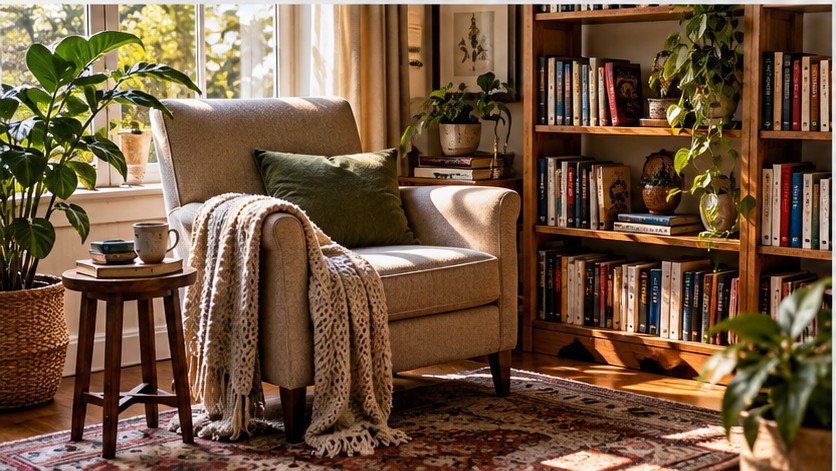
Many people like the idea of reading more, yet the weekend can disappear into errands, messages and the small tasks that accumulate during the week. A dedicated reading hour works because it is modest. It does not ask for a whole afternoon, a yearly target or a carefully curated stack of classics. It simply creates a short period in which a book becomes the easiest available choice.
The setting does not need to be a perfect library corner. A chair near a window, one lamp and somewhere to put a cup can be enough. What matters is reducing the little interruptions that make reading feel harder to begin than scrolling, tidying or checking one more notification.
Make the room do some of the work
Leave the current book where you intend to read it. If you use reading glasses, keep them there too. A folded blanket, a side table and warm light in the evening can make the space inviting without turning it into a decorating project. Comfort matters because a good chair removes a physical reason to get up after ten minutes.
Natural light is ideal when it is available, but glare can be tiring. Sit at an angle to the window rather than directly facing it, and use a lamp that illuminates the page without shining into your eyes. The aim is a place that supports attention quietly.
Phones are the most obvious source of interruption, but they do not need a dramatic ban. Put the device on charge across the room, switch on a quiet mode, or place it face down outside arm’s reach. The small increase in effort required to pick it up is often enough to keep you with the page.
Choose a book for the hour you actually have
A common mistake is selecting a book because it feels worthy rather than because you want to spend time with it. Weekend reading becomes easier when the book suits your current energy. A short story collection can be satisfying in brief sessions. A travel memoir may feel right after a busy week. A novel with a strong narrative can make the hour pass quickly.
It is also fine to keep two books in rotation. One might be immersive fiction; the other could be essays, photography, nature writing or something that works in shorter pieces. Variety removes the feeling that abandoning the wrong mood means abandoning the habit.
There is no need to track pages unless tracking is genuinely enjoyable. The hour can be measured by time rather than output. Some sessions will cover forty pages, others ten. A difficult paragraph may send you back to reread it; a familiar chapter may simply be pleasant company. None of that makes the session less useful.
A small ritual helps the weekend slow down
Connecting the reading hour to an existing part of the weekend gives it a natural place. It might begin after breakfast, after a walk, or during the quiet gap before dinner. Make tea, open the window for a few minutes, settle into the chair and begin where you left off. Repetition turns the sequence into a cue.
The value of the habit is not productivity. It is the change of pace. Reading for an hour lets attention rest on one thing long enough for a voice, an argument or a fictional world to develop properly. When the hour ends, mark the page and stop without feeling obliged to continue. A routine that leaves you wanting to return is easier to keep than one that becomes another weekend target.